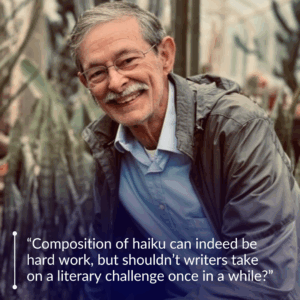
For this edition of Inside the Den, we’re pleased to introduce Alexander Lazarus Wolff, a poetry reader who has been volunteering with Black Fox Literary Magazine for the past two years. A gifted poet in his own right, Alexander brings to the submission queue a sharp eye for precision and emotional resonance. With experience as both a writer and editor, he approaches each poem with a deep appreciation for voice, image, and originality—looking not just for good work, but for pieces that can stand alone and make a lasting impact.
Black Fox Literary Magazine: Hi, Alexander, how did you become a poetry reader for Black Fox?
Alexander Lazarus Wolff: I first became involved with Black Fox when they accepted three of my poems when I was a rising junior at the College of William & Mary. A few years after, I saw they were accepting applications for their editorial board and here we are!
BFLM: What draws you into a poem right away?
ALW: I’m drawn in by a lot because master poets, while rare, have a variety of ways to hook the reader. Personally, I’m most drawn in by a level of precision in images: The poems are ones that can entwine emotion with a level of concrete detail. I like a speaker that is developed in both a literary and emotional sense, a speaker that can hold multiple points of view in mind without sacrificing the poem while still retaining an original voice. One examples is when a poem starts like an image that creates suspense with its tone while also serving for the poem as a whole. It isn’t technique for technique’s sake. A poem in second person, or beginning with an imperative, is another example of what I find compelling. But, ultimately, it is just good writing that grips me.
BFLM: What’s your biggest pet peeve when it comes to reading poetry submissons?
ALW: I’m not bothered by too much. It’s off putting when the cover letter is addressed to The Sun (an example of an actual submission I reviewed) when it should be clearly addressed to Black Fox. As a writer, I understand we can’t tailor each cover letter, but a basic template should be feasible. Another one is when writers just drop their bios in the cover letter space with no other greetings or formalities in the cover letter. (Often, these people submit poor work with their “bio” just being an affectation with a string of tiny magazines no one has heard of.)
BFLM: What’s something that elevates a poem from good to great for you?
ALW: When going through submissions, it’s important to remember that you don’t just need a “good” poem—you need a poem that will stand out and stand alone. Aside from what I mentioned earlier, I am most gripped whenever a writer can carefully control a sense of tension and release in a way that can only be intuitively understood. I’m also particularly drawn to poems that can portray familiar themes (love, loss, family, etc.) in an original or unique way that still retains a sense of respect to that which it is trying to portray. A lot of making a “good” poem to be a “great” poem is knowing when it’s okay to break “the rules,” for instance, such as the tasteful use of an abstraction or adjective.
BFLM: Has reading submissions changed the way you read or write poetry?
ALW: It hasn’t changed the way I write poetry, but it has changed the way I understand the professional side of the process. As assistant poetry editor at Gulf Coast, I get a lot of big names. Often, there will be several good submissions, but we must forgo a bigger name just to highlight a new voice, forgo a longer poem for page restraints, etc. As I mentioned earlier, a poem that would be good enough for a book might not be good enough for a literary magazine. It sounds counterintuitive, but some poems are more impactful in a collection because they operate on a broader scale.
BFLM: What’s a line of poetry you love and think about often?
ALW: A lot. At the moment, I’m preparing to go to the Ransom Center to look at Anne Sexton’s pages for a critical paper I’m writing. I would say Sexton’s first line from “Wanting to Die”: “Since you ask, most days I cannot remember.” It draws you in immediately just because of the authority of the voice and how it directly confronts the reader (in a good way).
BFLM: If your approach to reading poetry had a theme song, what would it be—and why?
ALW: Depends on the day (or hour): Maybe “Oh No!” by Marina and the Diamonds or “Wow” by Kate Bush.
BFLM: Many thanks, Alexander, for sharing your thoughts on poetry and the editorial process. We appreciate the care and insight you bring to the Black Fox team.
Stay tuned for more staff spotlights in upcoming editions of Inside the Den—because every page begins with a reader.

Alexander Lazarus Wolff’s writing appears in The Best American Poetry website, Cherry Tree, The North American Review, Poets.org, and elsewhere. A recipient of an Academy of American Poets prize, he teaches at the University of Houston where he is the Inprint MD Anderson Foundation Fellow and assistant poetry editor for Gulf Coast. He has received support from the Juniper Writing Institute, Sewanee Writers’ Conference, Kenyon Review Writers Workshop, and Napa Valley Writers Conference. He is entering the final year of his MFA at the University of Houston. You can read more of his work at www.alexanderlazaruswolff.com.