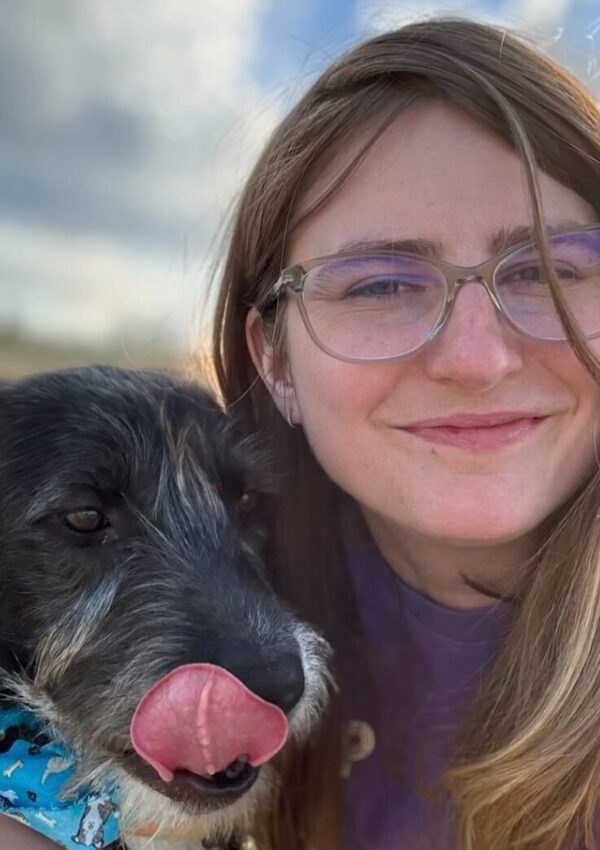
For this edition of Inside the Den, we’re shining the spotlight on Lillian Morton, who recently celebrated two years as a poetry reader with Black Fox. In that time, she’s become an essential part of our team—not only bringing her keen eye and lyrical sensibility to poetry submissions, but also stepping up this year to help review and format blog content for the magazine. Whether she’s weighing in on verse or shaping up posts behind the scenes, Lillian brings thoughtful attention to every line.
Black Fox Literary Magazine: Hi, Lillian, how did you become a poetry reader for Black Fox?
Lillian Morton: I joined Black Fox in 2023. I applied for the reader position a few months after the University of Washington Creative Writing MFA accepted my partner & I to the poetry track, and we spent the summer graduating with our BA from Colorado State, packing and moving, and selling a chunky catalogue of childhood clothes and books. Our families live two and a half hours apart on the Front Range and I used my downtime to get my ducks in order, usually on the internet (which I haven’t put down since receiving my own private MacBook Pro in 2011).
Applying (and subsequently accepting roughly a few weeks later) to the Black Fox readership felt like insurance that I’d maintain a connection to poetry outside of academia. I was excited about starting my MFA, but after a time in school, I struggled to be creative and happy in those places. I can truly become the most cynical version of myself when I’m a student, so it was important poetry existed in other areas of my life too and it had nothing to do with the scholarship of the content.
Even more of a reason for wanting to read for Black Fox is how much I love reading poetry from the general public. “Amateur” and “professional” poetry doesn’t exist in my perspective.
BFLM: What draws you into a poem right away?
LM: Voice—I have an allergy for overwritten poems. Being chronically online in the early 2010s, I acquired a baseline taste for the dramatic, romantic, but strikingly conversational Tumblr-type of poetry (which might make my allergy ironic, maybe hypocritical if you want to go for my throat).
Voice for me is all about the speaker owning what occurs/said in the poem. No demographic of submitters (those with or without graduate degrees) is consistent about voice, though. I have a theory this voice is more accessible to submitters who haven’t gotten themselves knee-deep in the current contemporary scene (and presumably reads whatever they want, no matter how “trashy” it could be regarded).
I wish I could describe the fine line between a confident speaker and an uncertain speaker that I distinctly search for in a poem. I gravitate toward poems that make me forget I’m reading a poem, which usually happens when the poem knows where to enter and how to land. Names who notably accomplish this effect for me are Linette Reeman (responsible for the poem, “Grand Theft (after Fall Out Boy)”) and Rowan Perez (known as rid.inkskinned on Tumblr, who the Tumblr-girlies might remember their “secret series” poetry; also author of Body’s a Bad Monster).
BFLM: What’s your biggest pet peeve when it comes to reading poetry submissions?
LM: Overall, I hate the clichés and the over-used metaphors. My eyes just glaze over the screen when the lines are filled with this sort of basic language. So many submissions are written by individuals who clearly love and breathe literature, and I’m still surprised to see the contemporary-poetry-equivalent of “roses are red.” After two years, I haven’t been able to discern if these poems are caused by overthinking the poem’s premise or overconfidence about the poem’s effect (how the devices and ideas function together).
BFLM: What’s something that elevates a poem from good to great for you?
LM: Honesty. (Similar to my response about voice.)
I hesitate to use authentic; it’s too subjective. But I think when the speaker is honest with themselves about the intensity of their feelings, the tone that it reflects in their language, and the images that an experience or subject inspires, it affects the entire flow of the poem from the form, line plus stanza breaks, and pacing.
For obvious reasons, I don’t read submissions with the intention to psycho-analyze. My preference for honesty doesn’t have anything at all to do with the author’s personal life (an important boundary when the submitters provide context in their cover letter), but rather the on-page circumstances of their speakers.
Sometimes the poems tapping into the “inner child” is notable and often intriguing to me.
BFLM: Has reading submissions changed the way you read or write poetry?
LM: No. I keep a boundary between my writing and a submission. This is so I can try to be neutral about my preferences while honoring the poem’s creative decisions. My criteria about voice, form, pacing, imagery, etc. is just a tool for selecting submissions in an already competitive process.
BFLM: What’s a line of poetry you love and think about often?
LM: Norman Boutin is a controversial “writer”—most infamously known for his Empress Theresa novel and his online “how-not-to” examples of being a professional-self-published author.
I’ve had an excerpt from, “JOAN OF ARC’S DEATH: From Heat Stroke,” saved on my Drive since finding it on my Dashboard years ago. The, “One minute since the fire was lit… / Two minutes since the fire was lit… / Three minutes since… / Four,” section. I just love medieval women, and I love their most unusual literary depictions (such as Robert Gluck’s Margery Kempe).
I didn’t know Norman Boutin authored “JOAN OF ARC’S DEATH” until recently. I haven’t decided how I feel about one of the most memorable portions of poetry coming from him.
BFLM: If your approach to reading poetry had a theme song, what would it be—and why?
LM: My music taste isn’t diverse, so if I’m reading poetry or submissions, I might turn on bodycam videos or very mid-tier late 2010’s indie movies (the digitally-filmed ones with then-soon to be A-listers that might’ve been on Netflix for a time, that you probably forgot soon after you watched it).
The bodycam videos sometimes serve to remind me that my life isn’t the worst (because I’m not getting busted for murder, or living with a brain persuaded to murder), but sometimes they’re funny enough.
The indie movies have to do with setting the right tone. It has nothing to do with slam-dunking mid-tier scripts and is entirely about my craving for simplicity or peace from another decade. I’m dependent on nostalgia.
I like to double-screen my set-up with the movie playing on my phone, and something else going on my iPad (which even has the minimized window or the split-screen function for extreme over-stimulation). It makes me feel like a child again in the ways I need to be with writing.
BFLM: Many thanks, Lillian, for sharing your perspective—and for the care you bring to both our poetry submission and blog content. We’re grateful to have your thoughtful voice on the Black Fox team.
Stay tuned for more staff spotlights in upcoming editions of Inside the Den—because every page begins with a reader.

(Photo Credit: Kobe Overby, 2024)
Lillian Morton spent her childhood in Huazhou, Central Ohio, and the Front Range of Colorado. Her poetry has been published in The Seventh Wave and received support from the Academy of American Poets. Today she lives in downtown Seattle with her partner, Kobe Overby, and their cat, Troy.